Menu
Close
ART INSTALLATIONS
ECO-SYSTEM LIGHTING THE INNOVATIVE AND GREEN
HERITAGE THROUGH TECHNOLOGIES
A sensory journey through light and space.
Four unique installations that transform the perception and experience of places.
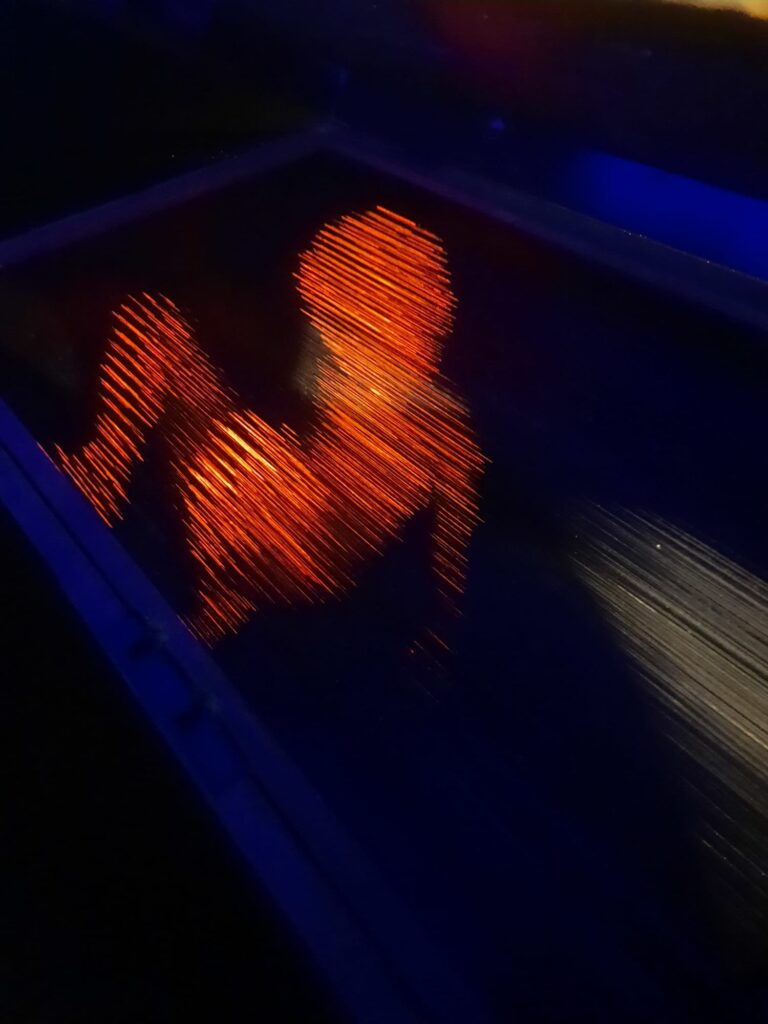
Immersive Exhibition "Densità Fluorescenti"
By Alessandro Lupi, Curators Gisella Gellini, Gaetano Corica
“Densità Fluorescenti use hand-painted polyester threads with fluorescent pigments and Wood lamps to create three-dimensional bodies of light — ethereal, transparent, and mostly empty space. This series explores the fusion of matter and energy, inviting viewers to question perception and reality.”
The Artistic Concept
In October 2024, the curatorial team developed the concept for a permanent light art installation to be hosted at the IID headquarters, aimed at revitalizing the partially degraded urban area of Parco della Pescaia. The selected concept, “Densità Fluorescenti”, takes inspiration from an existing body of work by artist Alessandro Lupi, known for his exploration of light and perception.
The project was integrated into the educational program of WP5 – Master in Light Design & Multimedia, involving students from both the Design and Multimedia tracks. Under the guidance of Prof. Monica Pioggia—Exhibit Design specialist and Art Director for major international festivals like Umbria Jazz and Eurochocolate—the students contributed directly to the installation and its communication strategy.
The academic team included key figures in the field:
– Arch. Gisella Gellini, scientific coordinator and professor of Light Art and the Culture of Light at Politecnico di Milano
– Dr. Gaetano Corica, research fellow at UNIVPM and expert in Black Light Art
– And of course, Alessandro Lupi, who conducted on-site teaching sessions in April and May 2025, travelling from his base in Berlin
“Densità Fluorescenti” became not only an urban art intervention but also a didactic output, with Design students curating the physical exhibition space and Multimedia students developing the visual identity and an interpretive video piece.
The installation was unveiled inside the former vault of the IID building, repurposed as a gallery space in collaboration with Samsung Italy (Pucciufficio). The site—branded as the “Exhibition Room”—is part of the OEL Labs outlined in WP2 and has already been featured as a case study on Samsung Italy’s official website.
The exhibition opened on May 13, 2025, and will remain on view for the entire duration of the ECO-Light Project.
The Language of Black Light Art
Densità Fluorescenti is a series of works created starting in 1997, using polyester threads hand-painted with fluorescent and/or photoluminescent pigments.
These threads, illuminated by Wood lamps, bring to life three-dimensional, ethereal, transparent human bodies essentially made of light. Although they appear dense and compact, they are actually composed of 95% emptiness.
The concept refers to the interconversion between matter and energy theorized by Einstein, where light and energy merge and transform into matter, but also to the perceptual illusion that drives our visual system to ‘fill in the gaps’ — a phenomenon that fascinated both Kandinsky and the German Gestalt psychologists.
These are works of Black Light Art, an artistic movement linked to the use of Wood lamps and fluorescent pigments and materials. The first experiments date back to 1940 with Lucio Fontana’s “Spatial Environment in Black Light,” one of the earliest to approach this kind of investigation in his studies related to Spatialism.
Throughout the twentieth century, this experimentation attracted the interest of many prominent artists, including Gianni Colombo and Dadamaino, and continues to represent a fascinating perspective of research and experimentation for many contemporary artists.
Alessandro Lupi’s selection emerged from numerous international artists working in this field.
The exhibition project was born as a project work by students from the Design and Multimedia courses of the Light Art and Culture of Light course (WP5 action of the Project) held by curators Gaetano Corica and Gisella Gellini at the new OEL (WP2 action of the Project) of the Italian Design Institute with the students, in collaboration with professors Monica Pioggia and Nicola Alessandrini and artist Alessandro Lupi.
The students are the authors of the installation design and communication (Multimedia) for the exhibition.
The course represented a fruitful collaboration between students and industry professionals aimed at creating an event of great artistic value (included in WP3 action of the Light Art Project).
PRESS REVIEW
The exhibition “Densità Fluorescenti” by Alessandro Lupi has received extensive coverage from key local and national media, highlighting the installation’s significance within Light Art and urban regeneration.
Below are some of the main articles covering the event:
- PerugiaToday – "Alessandro Lupi Exhibition at the Italian Design Institute" (May 12, 2025)
- Umbria24 – "In Perugia, Light Becomes Art with Alessandro Lupi’s Fluorescent Densities at the Italian Design Institute" (May 14, 2025)
- Umbria24 – "Densità Fluorescenti in Perugia: The Visual Artist Alessandro Lupi’s Exhibition" (May 12, 2025)
- RaiNews (TGR Umbria) – Video report: “Fluorescent Densities at the Italian Design Institute” (May 16, 2025)
RaiNews (TGR Umbria) – Video report: “Fluorescent Densities at the Italian Design Institute”
Watch the video
These articles provide insights into the installation, the artist’s creative process, and the cultural impact of the work within the urban context of Perugia.
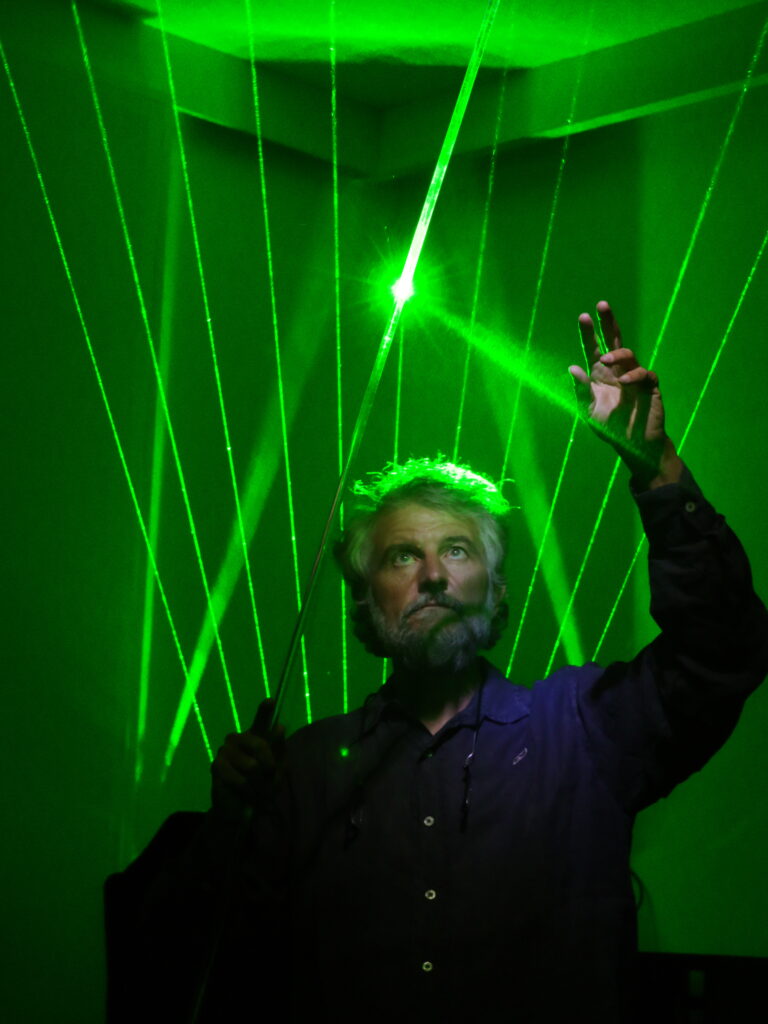
Light & Music with Laser Harp "Arpa di Luce", Umbria Jazz
By Pietro Pirelli with Gianpietro Grossi, Curators Gisella Gellini, Gaetano Corica
“Arpa di Luce is an immense immaterial harp whose laser light strings create an instrument that transforms space into a multi-sensory musical and visual experience. Not only played by the artist, but also by the audience.”
The Artistic Concept
In October 2024, the artistic team worked closely with artist Pietro Pirelli to develop an installation and performance that would resonate with the spirit of Umbria Jazz—a festival deeply rooted in the region yet renowned worldwide.
At the same time, the Project Manager maintained ongoing dialogue with local institutions and with Fondazione CariPerugia Arte and Umbria Jazz Foundation to identify the most suitable location and ensure the inclusion of the work within the festival’s official program.
For this edition, the curators proposed “Arpa di Luce” by Pirelli, an artwork that perfectly intertwines the Project’s central theme—Light—with Music, creating a poetic synthesis between the two.
ARPA DI LUCE
Arpa di Luce is a monumental, immaterial instrument whose strings appear as beams of laser light.
Created by Pietro Pirelli and Giampietro Grossi—who developed its visual-musical concept and its technical-realization, respectively—it transforms the space around it into a living musical instrument.
While Pirelli uses it in his performances, the Laser Harp is also interactive, inviting the audience to play it. Each movement across the laser strings produces extraordinary visual effects that naturally correspond to the musical gesture: sound and light become one.
Suspended between invention and artwork, the Harp becomes a poetic medium through which to reinterpret space and engage people through touch—whether with hands or through objects such as a large pendulum swinging between the laser beams.
A custom software developed by Pirelli allows the oscillatory motion of the pendulum to generate an hypnotic and immersive sound composition, exploring the intimate relationship between music and physical vibration, the very origin of sound itself.
(Below: three images of artistic events and live performances featuring the Laser Harp.)
Collaboration and Site Selection
For the artistic installation, the Project Manager initiated dialogue with various foundations, taking into account the indications provided by both the curators and the artist.
On December 4, 2024, a meeting was held at the headquarters of the lead institution between the Project Manager, artist-musician Pietro Pirelli, engineer Gianpietro Grossi, curators Arch. Gisella Gellini and Dr. Gaetano Corica, and representatives from Fondazione CariPerugia Arte (Director Maria Cristina De Angelis) and Fondazione Umbria Jazz (President Avv. Gianluca Laurenzi, Production Director Stefano Lazzari).
During the meeting, several potential sites were considered to best enhance the characteristics of the Laser Harp:
Cloister of San Domenico
Cloister of San Pietro
Hall of the Altarpieces, Palazzo Baldeschi
The final choice fell on the Hall of the Altarpieces at Palazzo Baldeschi al Corso, a venue managed by Fondazione CariPerugia Arte, one of the project’s main supporters.
Art, Education and Community
The artistic component was integrated into an educational program developed in collaboration with the F. Morlacchi Conservatory of Perugia, alongside the project’s musical partner, G. Briccialdi Conservatory.
A delegation of musicians, artists, and photographers—together with the Project’s Scientific Director and Project Manager—was based in the historic center of Perugia from July 9 to 21, 2025.
The first two days were dedicated to transporting, unloading, and installing Arpa di Luce within the Hall of the Altarpieces at Palazzo Baldeschi al Corso Vannucci, a central hub of the Umbria Jazz Festival.
From July 11 to 20, throughout the entire festival, the delegation included:
- Maestro Pietro Pirelli, Ing. Gianpietro Grossi, Maestro Antonello Raggi (musicians and specialists in the Laser Harp, from Milan/Varese)
- Arch. Gisella Gellini, Scientific Director of the Project and Professor of Light Art at Politecnico di Milano
- Sofiya Chotyrbok, photographer specializing in Laser Harp performance documentation
The musicians conducted an experiential educational workshop for students of the Harp Department at the F. Morlacchi Conservatory of Perugia, led by Professor Silvia Vicario.
During this period, the students also attended at least six live concert sessions integrated into the official program of Umbria Jazz, gaining direct exposure to immersive artistic performance.
Educational Framework and Objectives
The educational program was embedded within two project work packages:
- WP3 – Artistic Development
- WP6 “New Generations” – Training and Innovation
This dual framework positioned the initiative as a formative and research-based activity, aimed at “exploring new artistic methods to promote research and culture while considering environmental, social, and territorial impacts.”
In particular, the training process was defined as follows:
“Artists, multidisciplinary experts, event organizers, and educators design, as a result of their research on Light Culture, immersive events and installations that engage a wider public in the appreciation of both scientific and artistic research.”
Through this educational and performative journey, the action led to the artistic and musical production of Light Art—a synthesis of installation, sound, and immersive experience.
(Below: teaching outline and schedule of the educational course conducted by Pietro Pirelli, Gianpietro Grossi, and Antonello Raggi.)
Course Title:
“Playing the Laser Harp”
Course Title: “Playing the Laser Harp”
Learning Objectives: The course aims to help participants understand the artistic functioning of the “Laser Harp”, a monumental immaterial instrument whose strings appear as beams of laser light. Participants explore both the visual-musical conception and the technical-realization of the instrument, as explained by Pietro Pirelli and Gianpietro Grossi.
Course Description: “Playing the Laser Harp” is a hands-on, immersive learning experience designed to explore the interaction between light and sound. Through talks, guided reflections, practical exercises, and direct engagement with the instrument, participants analyze the unique dynamics of this musical device. The course includes direct experimentation with the Laser Harp, which can also be played by the public. Interacting with the instrument transforms the surrounding environment into a living musical space, where every gesture produces striking visual effects naturally connected to the musical intention. Here, sound and light coincide. Pirelli also shares his expertise in digital technologies, acquired over decades, including through his work with the Milan-based AGON Center, which he co-founded in 1990. Participants learn how physical oscillatory phenomena—like the pendulum—are harnessed in his installations. The musical experimentation component focuses on the exploration of sound as a material, transforming it into visual forms through installation. The course concludes with a presentation of Pirelli’s international case studies, including projects in India, South Korea, Japan, Germany, and France, as well as exhibitions at the Biennale della Musica di Venezia, Museo Testaccio and Palazzo Venezia in Rome, Pio Monte in Naples, Ravenna Festival, Fabbrica del Vapore in Milan, and the Light Art Biennale in Mantua at Casa del Mantegna.
Additional Activities & Results: During the two-week program, a documentary film was produced by project partner Poliarte. The initiative was very successful, with over 200 visitors attending the Laser Harp installation at Palazzo Baldeschi. The following images/documents are included:
- Protocol letter from F. Morlacchi Conservatory confirming participation of the Harp course led by Prof. Silvia Vicario (profile link)
- Official 2025 Umbria Jazz Festival program, highlighting PNRR funding for the project
- Promotional materials and online communications
press review
The Arpa di Luce project by Pietro Pirelli at Palazzo Baldeschi has been widely featured in the press, highlighting its innovative fusion of light, music, and immersive art.
Discover what the media wrote about the installation:
These articles provide insights into the installation, the artist’s creative process, and the cultural impact of the work within the urban context of Perugia.
Umbria Jazz 2025 | Official Program
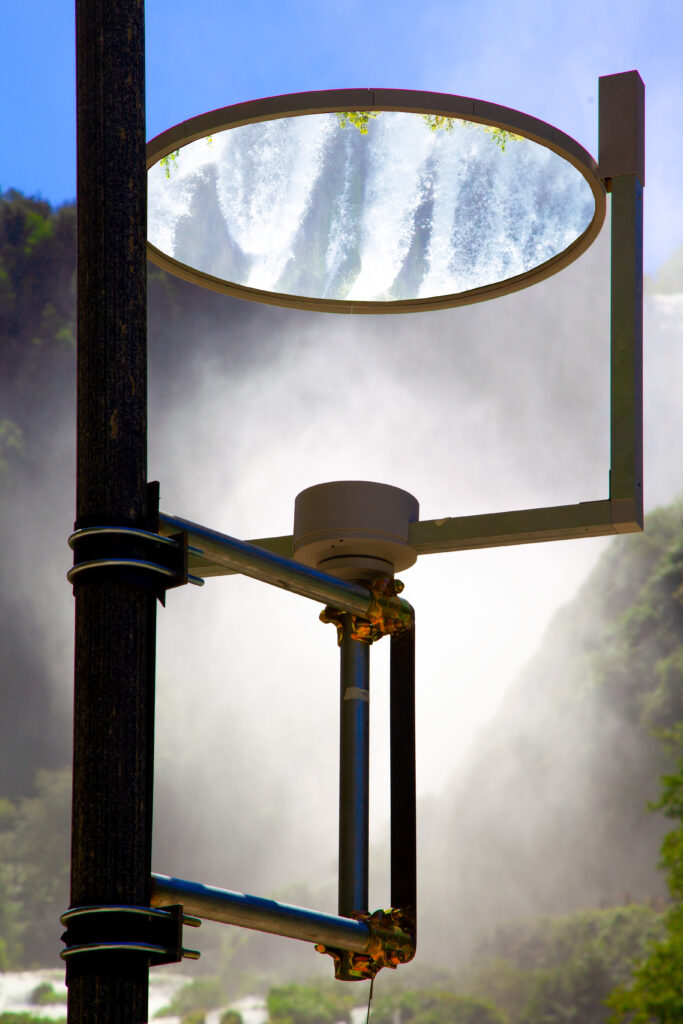
Site Specific Art "ELIOS - Solar Land Art", Marmore Falls
By Alessandro Lupi, Curators Gisella Gellini, Gaetano Corica
“ELIOS is a kinetic, site-specific solar artwork that uses five heliostats to direct sunlight onto the mist and waters of the falls, generating dynamic light and color plays. Powered entirely by solar energy, it celebrates nature, technology, and sustainability in perfect harmony.”
Introduction – A Sustainable Gesture of Light
The project by Alessandro Lupi for the Cascate delle Marmore emerges as a sustainable artistic gesture, designed to collaborate with nature rather than alter it.
The installation enhances existing natural light phenomena of the site without any artificial lighting or electrical connection, relying solely on small solar panels for energy.
Physically, the work consists of five heliostats—round mirrors with a diameter of 60 cm—mounted on existing site structures (fences, posts, or temporary supports) to avoid permanent interventions.
The installation remains “dormant” most of the time, activating only for short intervals of a few minutes, as agreed with environmental authorities. The project’s duration is estimated at three months.
Its purpose is to amplify the natural wonder of light and color produced when sunlight meets the mist surrounding the waterfall—enhancing luminous textures and, at times, rainbow fragments already naturally present at the site.
Key principles:
- Environmental and landscape preservation
- Valorization of natural phenomena
- Respectful artistic intervention
- Art as an amplification of wonder
- Environmental and energetic sustainability
- A contemporary vision of harmony between art and nature
The Project – Site-Specific Solar Installation
“Elios” is a solar-powered site-specific artwork. It involves five heliostats—circular mirrors capable of moving on two axes—programmed to reflect sunlight at specific times, producing dynamic light effects with the water of the falls.
Each heliostat operates autonomously, powered by solar panels and lithium batteries, and is synchronized via a digital controller that adapts to the solar inclination and daylight conditions.
By reflecting beams of sunlight from various angles, the system generates three-dimensional light formations and overlapping rainbows. The timing of activations depends on natural light, sun position, and environmental conditions, ensuring harmony with the site’s hydrological and ecological rhythms.
No construction site or road access is required, as the devices are installed on existing structures using adjustable clamps or temporary supports, pending authorization from environmental authorities.
Technical Description – Movement, Light, and Reflection
Each heliostat is equipped with servo-mechanisms allowing two-axis rotation and precise solar tracking. Mounted on aluminum poles, the mirrors include a rear solar panel and a battery system for motion control.
When inactive, the mirrors turn their solar side toward the sun to recharge; when activated, they redirect sunlight into the misty air of the waterfall, generating a living interplay of light, water, and air.
This choreography of beams produces shifting, three-dimensional reflections—a pure, ephemeral dialogue between light and nature.
Environmental specialists, including botanists and chiropterologists, will monitor and guide the installation to ensure no impact on local flora or fauna. The project’s timing and duration were adjusted accordingly to guarantee full ecological sustainability.
Visual Studies and Mapping
Preliminary mapping using Google Maps and QGIS identified five ideal heliostat positions (marked in blue). Adjustments may occur after field inspections to optimize solar reflection angles.
Due to the north-facing orientation of the waterfalls, sunlight enters from varying angles throughout the day, generating an ever-changing contrast of light beams and multiple rainbow layers.
Photomontages illustrate the scenic effect achievable even with only two heliostats, emphasizing the subtle, natural amplification of existing light phenomena—never artificial or invasive.
Environmental Sustainability & Authorizations
The project received full institutional approval:
- A. Landscape Superintendence & Municipality of Terni
→ Positive authorization for landscape compatibility.
- B. Umbria Region – Environmental Directorate (Protected Areas Section)
→ Environmental Impact Assessment (VINCA) approved (Determination No. 1705, 19/02/2025), confirming no direct or indirect impact on the local ecosystem.
A press conference was held on July 17, 2025, at Palazzo Spada in Terni, attended by municipal representatives, the ECO-Light Project Manager, the Scientific Director, and institutional partners.
Installation took place in July 2025, followed by interviews with the artist for the Poliarte Docu-Film. The work was officially inaugurated on July 25, 2025, and later celebrated with a special concert event.
“Concert at the CASCATA DELLE MARMORE” – Musical Event, August 30, 2025
Midway through the exhibition period, a concert at Cascate delle Marmore was organized by project partner G. Briccialdi Conservatory of Terni to highlight the site musically and visually.
The program spanned from the English Renaissance to contemporary music, featuring works by Byrd, Gabrieli, Händel, Holst, Britten, Shostakovich, Premru, and Sibelius.
Faculty and Performers:
- Prof. Marco Venturi – French horns
- Prof. Andrea Di Mario – Trumpets
- Prof. Massimiliano Costanzi – Trombones
Together with their students, they formed an ensemble representing the excellence of Terni’s musical education.
Concert Program:
W. Byrd – The Earle of Oxford’s March
G. Gabrieli – Canzon Septimi toni No. 1 & 2
G. F. Händel – Water Music Suite
G. Holst – Suite No. 2 – March
B. Britten – Russian Funeral
D. Shostakovich – Overture from The Gadfly
R. Premru – Le bateau sur Léman and
Blues March (from Divertimento)
J. Sibelius – Finlandia
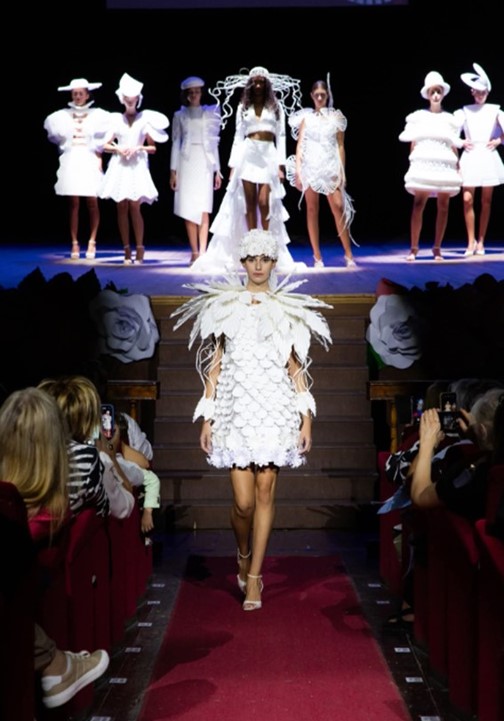
Light & Fashion "Paper Crazy Runway", Fabriano Festival
By James Dimech , Curators Eleonora Granieri, Sara Palazzetti
“Paper Runway” is a luminous fashion performance celebrating creativity, craftsmanship, and sustainability. Designed by students of the Italian Institute of Design under the guidance of artist James Dimech, the collection transforms paper into light-infused couture within Fabriano, UNESCO Creative City of Crafts and Folk Art.
The Artistic Concept
Starting in June 2024, the Italian Institute of Design (IID) initiated a dialogue with the Municipality of Fabriano, specifically with the Councillor for Beauty, Dr. Maura Nataloni.
In collaboration with Prof. Eleonora Granieri, Coordinator of the Fashion Design Department, the team conducted site visits to design the event “Sfilata di Carta e Luce”—later titled “Paper Runway.”
The initiative was conceived within the framework of WP3, focusing on the enhancement of UNESCO urban heritage through artistic action.
After several meetings, IID and the City of Fabriano selected the local festival “Fabriano Carta è Cultura” (Fabriano: Paper is Culture) in September 2025 as the ideal context for the event.
Councillor Nataloni included Paper Runway not only in the festival program but also presented it to the UNESCO Creative Cities Forum, submitting it in the international dossier to UNESCO Paris among ten high-value initiatives.
In parallel, IID, together with the Municipality and Fondazione CariPerugia Arte, included the Paper and Watermark Museum of Fabriano within the educational program of WP7 “Spotlight Museums”, thus strengthening the project’s cultural and territorial network.
Educational Program (WP3)
o enrich the event’s artistic and didactic value, IID invited the renowned Maltese-British architect and artist James Dimech to guide students in developing the final educational output — a paper fashion collection for the runway.
The year-long course was divided into two main modules:
Module 1 – “Fashion Illustration, Garment Design & Collection Development”
- Lecturer: Prof. Eleonora Granieri
- Duration: 32 hours of lectures + 64 hours of practical workshops
- Period: October – December 2024
- Format: In-person, IID headquarters
Module 2 – “Paper Collection Development”
- Lecturer: Prof. James Dimech
- Duration: 32 hours of lectures + 64 hours of practical workshops
- Period: April – September 2025
- Format: Hybrid (online from Malta and in-person at IID during Dimech’s missions to Perugia under WP3)
“Paper Crazy” Collection and the Fabriano Runway Event
Following a full academic year of development, students completed the “Paper Crazy” collection, showcased during the runway event on 12 September 2025 at the Teatro Gentile in Fabriano, as part of the official UNESCO festival “Fabriano: Carta è Cultura.”
Prof. Dimech conducted over 40 hours of mixed-format sessions with the students, combining artistic guidance, technical know-how, and experimentation with sustainable paper materials.
The event, filmed by RAI Play for the international program “Paparazzi” (episode aired on 16 September 2025), was met with widespread acclaim.
The national press praised the initiative, writing:
“Extraordinary and warmly received at Teatro Gentile, the paper fashion show by Maltese architect and designer James Dimech, promoted by the Italian Institute of Design in Perugia with Poliarte.”
UNESCO and Cultural Impact
By merging education, sustainability, and design innovation, Paper Runway exemplified how contemporary art can celebrate the heritage of paper-making — a centuries-old craft at the heart of Fabriano’s identity and its UNESCO Creative City status.
The project strengthened collaborations between institutions, artists, and students, enhancing the city’s international visibility through creativity and craftsmanship.
Runway in Milano Fashion Week, 26/09/2025 - Chiostri di San Barnaba
Paper Runway also showcased at Milano Fashion Week, at Chiostri di San Barnaba, on the 26th of September, 2025.
Exhibition in Merano Wine Festival, 7-11/11/2025 - Art of Packaging
The exhibition “Art of Packaging: PAPER CRAZY” by James Dimech, held at the Merano WineFestival from 7 to 11 November 2025, represents a coherent implementation of ECO-Light objectives, especially under WP3 and WP12. Through the works Vendemmia and Vigna Regina, created with Cork Paper, Kraft-Tex, Milk Tissue Paper, recycled paper sheets and hand-braided paper rope, the initiative explored sustainable materials, artistic experimentation and the reinterpretation of local cultural heritage through contemporary design. The collaboration with students of Istituto Italiano Design in the creation of the paper grape clusters also strengthened the project’s educational and participatory dimension. Hosted within a high-visibility international event, the exhibition significantly supported the dissemination of ECO-Light artistic and design activities, enhancing public outreach, cross-sector visibility and project storytelling.
PRESS REVIEW
The event received national media attention for its originality and sustainable approach to fashion design.

Project supporters
IN partership with

financed by

“ECO-LIGHT” – acronym for “Eco-System Lighting the Innovative and Green Heritage through Technologies” – is an initiative funded under Directorial Decree No. 124/2023 of the Italian Ministry of University and Research (project code: INTAFAM000_49, E96E24000000001). The project is designed to enhance the AFAM network (Alta Formazione Artistica, Musicale e Coreutica) and promote its internationalization through a wide range of experiences, activities, and programs focused on communication, dissemination, awareness, education, research, and artistic production. These actions aim to preserve and promote Italian culture and the values of Made in Italy, supporting the transmission of heritage through innovation and sustainability. ECO-LIGHT is committed to broadening access to Italy’s rich cultural, artistic, musical, and choreographic heritage—ensuring optimal conditions for public engagement and enjoyment, while boosting its visibility and attractiveness on an international scale.
© 2025 | Tutti i diritti sono riservati a © Istituto Italiano Design ANWA SRL - P.IVA 02453910545| Privacy & Cookie Policy